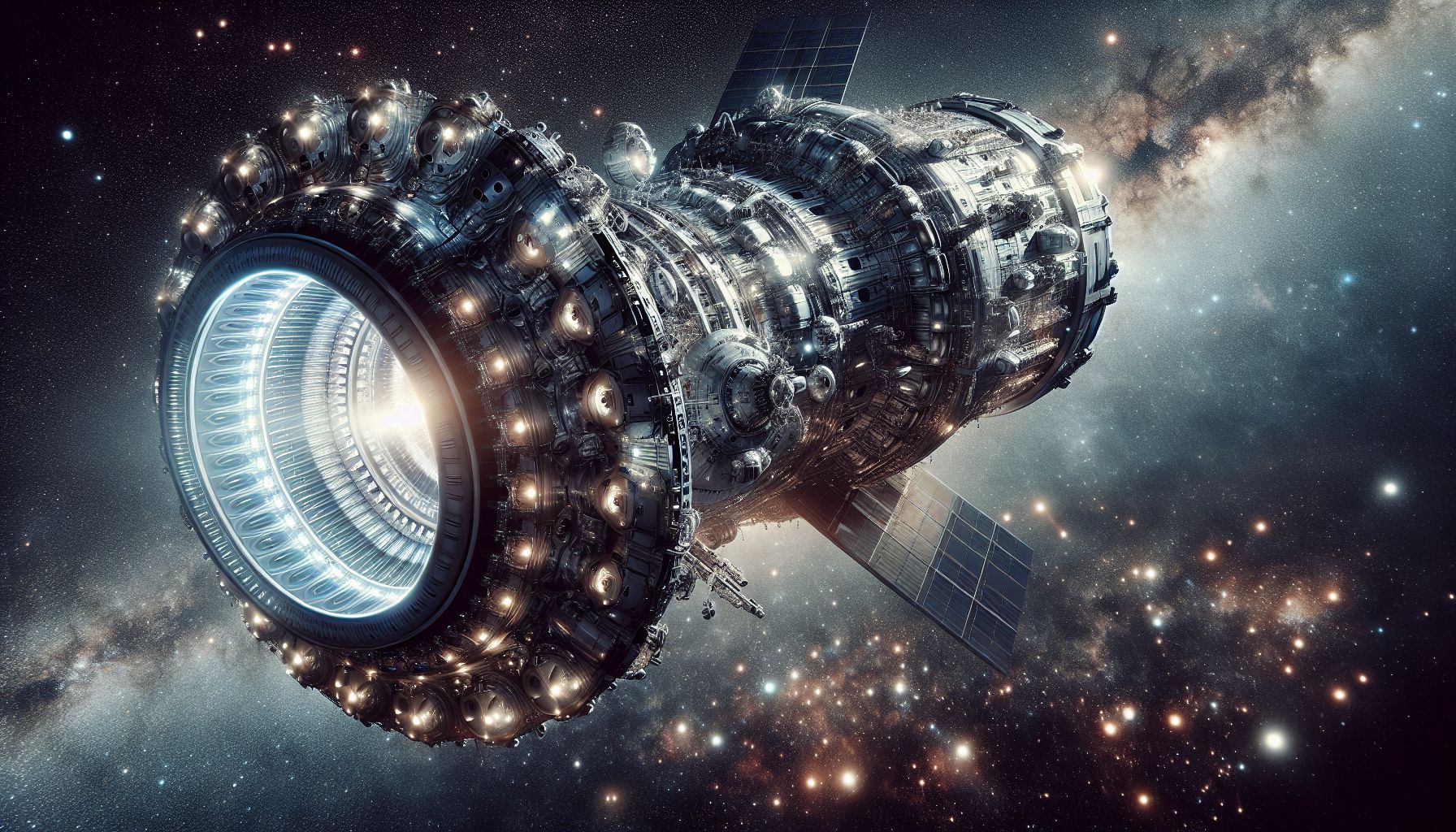
Hey folks! You know, space is never short of umph, wonder, and let’s admit it, caffeinated nerds geeked out on making the impossible, possible (and hopefully profitable). But today, we’re not going to talk about Elon Musk sending his Tesla Roadster to Mars or Blue Origin’s phallic rocket (keep it classy, Bezos). No, the subject at hand is far more exciting: fusion propulsion technology for space travel.
This is stuff of Star Trek, where “engage Warp Speed” isn’t just cool lingo for Captain Picard, but actual science. Better grab another coffee, because this ride is going to be stellar.
Powered by Plasma: Understanding Fusion Propulsion
It’s basic physics folks. Chemical rockets are good for escaping Earth’s gravitational pull (hee-haw!), but when it comes to cross-country road-trips in the cosmos, they are like you choosing a tricycle for an interstate highway.
Fusion propulsion on the other hand, think of it as a hyper-speed intergalactic Tesla Roadster. Fusion reactors use hydrogen isotopes to create a plasma propulsion system. When these isotopes get all chummy and hot, they fuse, producing helium, a plucky little neutron, and a crap-ton of energy. We’re talking nearly 4 million times more than a chemical reaction.
Sparking the Plasma Engine: Recent Milestones
I can hear what you’re thinking: if fusion propulsion is so hot, why are we still fussing around with those sluggish chemical rockets? Well, fusion propulsion has long been the unicorn of the space community. Much hyped, but elusive. It’s not an easy task to contain the kind of temperatures we’re talking about. The last I checked, no one has an “infinity-plus degrees Celsius-resistant” pot lying around.
But recently there’s been some huge leaps. A team at the Princeton Plasma Physics Laboratory have discovered new ways of stabilizing this process. Their miniaturized fusion reactor, named the Princeton Field-Reversed Configuration, could eventually reduce trip times to Mars to merely weeks. No more missing out on birthdays!
Then there’s the Helicity Drive Project by the Advanced Propulsion Laboratory. The new kid in town that certainly shows promise for fast, efficient space travel.
Spacefaring with Ease: Implications of Fusion Propulsion
What does it mean for us, beyond karma points for science nerds? Quite a lot, actually.
Faster space travel changes the game completely. It opens up new possibilities for exploring the universe. Longer, more daring missions become possible without worrying about the availability of pizza delivery (although I’ve heard Martian pizza sucks, but hey, beggars can’t be choosers).
Speeding up access to distant celestial bodies also has profound economic implications. Think asteroid mining, Helium-3 extraction for clean energy on Earth, and don’t forget the budding space tourism market. Who doesn’t want to party on Mars, or honeymoon on Neptune?
Tackling the Challenges: Fusion Propulsion Ain’t a Cakewalk
However, fusion propulsion isn’t without its challenges. Sure, it takes us closer to being the juggernauts of cosmic exploration, but at what cost?
First, the technology is still in its infancy. The initial investment in research, development, and testing is astronomical (pun intended).
Safety considerations are also paramount. Let’s not forget, folks, we are dealing with plasma hotter than the Sun. We wouldn’t want to inadvertently script another explosive chapter in space explorations, now would we?
Artificial Stars: The Future Ahead
So, what’s the future of fusion propulsion? It’s overwhelmingly positive (if you ask me after my third espresso shot). As we continue to refine this technology, fusion propulsion might just be our ticket to unlocking the vastness of space.
Trips to Mars could be the first successful test drive. After that, the sky’s the limit. Or rather, the cosmos is the limit.
Yes, we have steps to climb, hurdles to jump, probably a few nerf wars to settle at NASA. But the day when we can hop on a fusion-powered cruise to Jupiter for a weekend getaway might not be as far away as we think. At least that’s my bet, and I don’t do Vegas, so you know I mean it.
And with that, I bid you a day full of cosmic breakthroughs and caffeinated epiphanies. As they say in space, “Ad astra per aspera” – through hardships, to the stars. Sweet.