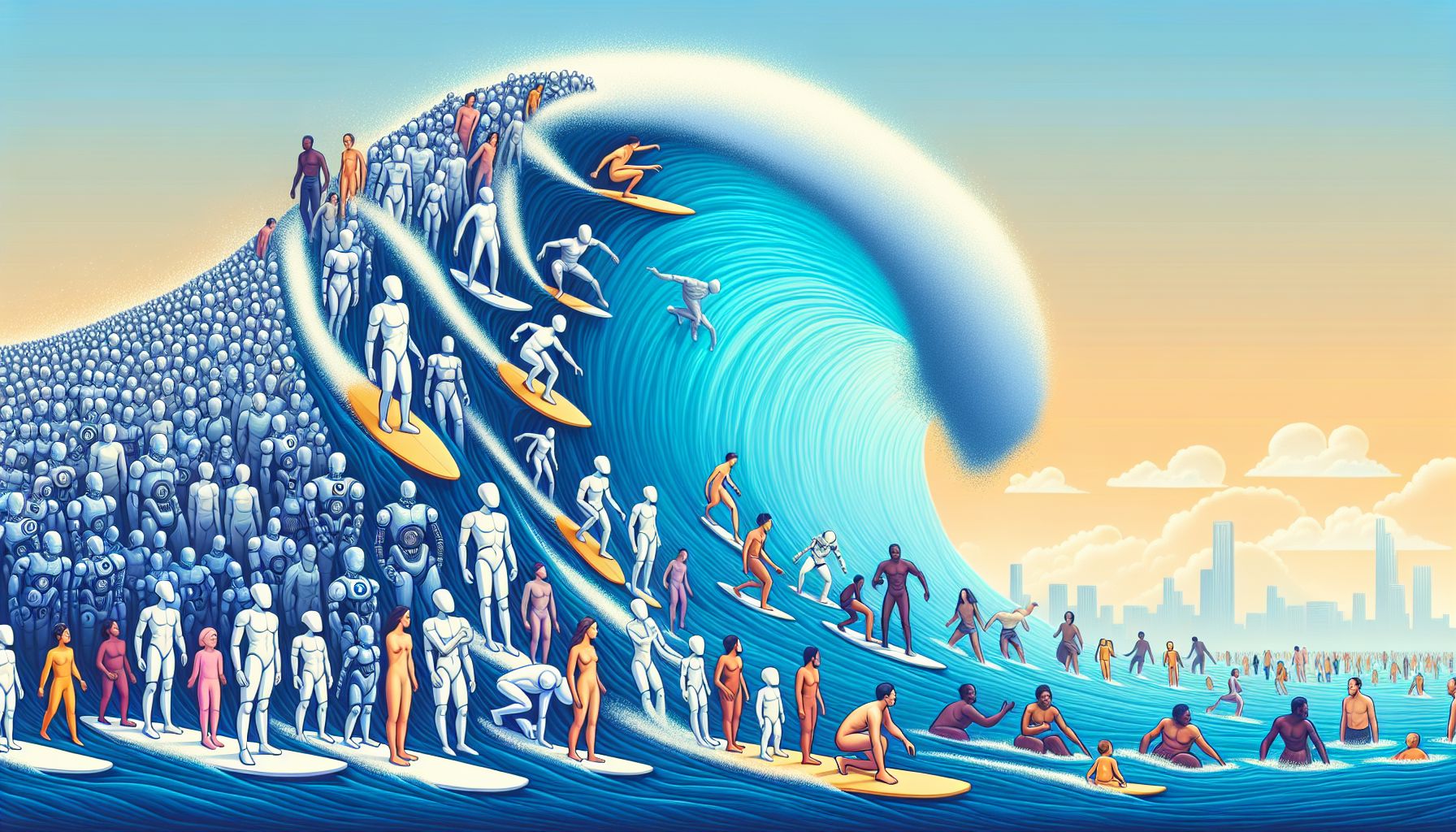
Hello there, tech-savvy friends and truth seekers! Ready for a wild story to brighten up your day? Today, let’s jump into the colorful collision where Art meets Artificial Intelligence (AI). Yes, you heard it right, the brush strokes of Van Gogh and the poetic verses of Shakespeare are getting AI makeovers. I know, it sounds like something straight out of a sci-fi movie, but welcome to 2022, folks!
AI: The New Picasso in the Room
Remember when we used to think that creativity was solely a human thing? Well, artists might want to hold on to their berets, because AI is strutting into the gallery. AI-generated art isn’t just a future promise anymore. It’s here, it’s now, and it’s real.
The artistic applications of AI have exploded in recent years, and work produced by AI is getting recognized in its own right. For instance, Paris-based collective Obvious had their artwork “Portrait of Edmond de Belamy” sold at Christie’s for an astonishing $432K. The entire thing was created by AI.
Poetry, but not as we know it
Poetry has always been seen as a deeply personal and emotional form of expression. But nowadays, it’s not just us humans spewing sonnets. AI models, like OpenAI’s GPT-3 language model, are helping to transform what we think of poetry.
Is it chilling to see our raw emotions replicated by a machine? Maybe. Or perhaps, it shows off our engineering skills. Either way, it’s equally fascinating and terrifying to see AI compose a piece that could bring tears to your eyes.
Music to my (Metallic) Ears
But why stop at visual and literary arts? Let’s amp it up a notch. AI is also shaking things up in the music industry. MuseNet, another brainchild of OpenAI, is a deep learning model that can generate four-minute songs with ten different instruments, spanning multiple genres, from country to Mozart to the Beatles. Imagine the possibilities, musicians collaborating with AI to compose unique symphonies. It’s like having Beethoven’s spirit in your laptop!
Challenges on the Creative Frontier
As exciting as this is, there are definitely some challenging aspects to consider. For instance, who owns the rights to the art created by AI? Is it the developers of the AI model or the AI itself? And what about authenticity? There’s something incredibly personal about human creativity that an AI, in its silicon heart, might never truly replicate.
Also, let’s not ignore the fact that these developments may displace some artists and musicians. It’s a threat to creative jobs that needs to be seriously addressed.
Forward to the Future
Even with these challenges, AI in creative arts is a fascinating field that’s bursting with potential. I look forward to seeing more collaboration between artists and AI, more unique creations, and perhaps an AI-composed chart-topper? Never say never.
So, what do we take away from this? It’s clear that AI is becoming a growing force in the world of creativity, one that cannot be ignored. Let’s embrace it for the uncharted potential it brings.
But let’s be careful to remember that AI is a tool, not a replacement. There’s something incredibly special about the human touch in art that a machine can’t replicate. Or as yet, to my knowledge, can’t feel chills down their metallic spines when looking at the beauty of a Van Gogh painting. They are missing out, aren’t they?
Catch you in the next one, tech lovers! Until then, stay fascinated and keep exploring. And next time you find yourself lost in a beautiful piece of art or enchanted by a clever sonnet, remember, it might just be the brainchild of an AI operating right now in a server rack somewhere. The future, as they say, is now.