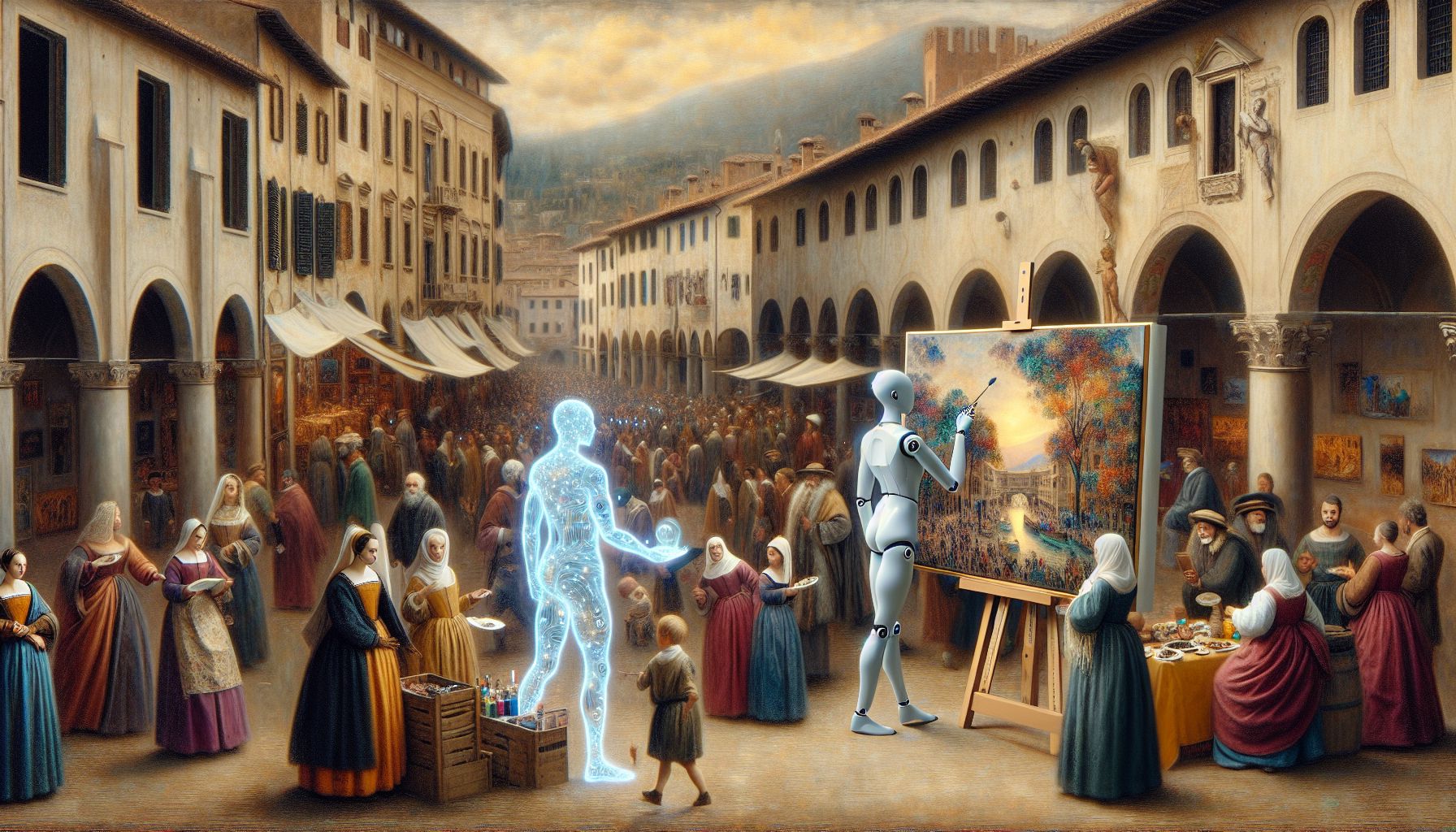
Hi there, fellow tech-enthusiasts! Can I tell you something today? I’ve been utterly dumbfounded recently, not by the latest Tesla models or Apple gadgets. No, no. I’ve been staring at paintings, believe it or not! I keep finding myself wandering through modern galleries, completely absorbed by art pieces that shouldn’t make sense to my tech brain. But you know what else has been blowing my mind? This wild intersection of AI and creative arts that’s happening right now.
And today, I’m fired up to share what I’ve discovered about AI and painting. Sounds like mixing oil and water, doesn’t it? But trust me, you’re going to want to read on!
An Unexpected Combination: AI and the Canvas
It started with pure curiosity. A few years back, I stumbled upon the work of Ahmed Elgammal, a computer science professor from Rutgers University. Elgammal had developed an AI model called AICAN that was producing art so convincing that critics couldn’t tell it apart from human-created pieces. I was genuinely blown away! I mean, could AI really produce something that moves you emotionally?
Well, turns out they can, and we’re not talking amateur hour here. These artificial artists have their work displayed in renowned galleries across the globe. Who would have thought?
How Does AI create Art?
You might be wondering, how does the AI make the magic happen? Here’s the simplified version: we feed an AI system thousands or even millions of images of art.
These aren’t random scribbles, mind you. We’re talking classic works, contemporary masterpieces, Cubism, Impressionism – everything. Then we turn the AI loose and let it crunch, analyze, and learn. Using deep learning techniques, the AI tries to understand what makes art tick: recurring themes, patterns, color gradients, compositional rules.
Imagine a kid who grows up watching a world-renowned artist paint every single day. They’d naturally pick up techniques and develop an eye, right? Well, AI does that, except it’s learning from thousands of world-renowned artists simultaneously. Kind of puts a new spin on “Learning from the Masters,” doesn’t it?
The Masterpieces of AI
One of the most memorable projects in AI painting has to be Robbie Barrat’s work. This talented young programmer fed an AI over 5,000 portraits from the 15th to 20th centuries. The AI then started creating its own portraits.
But here’s where it gets interesting – it wasn’t simple copying. The AI started adding unique twists and features of its own, showing a depth of creativity that honestly surprised me. Its work, “Portrait of Edmond Belamy,” sold at Christie’s New York for a jaw-dropping $432,500!
I’m telling you, AI has picked up a paintbrush, and it’s making some serious waves in the art world!
The Future of AI in Painting
So where do we go from here? Will AI replace human artists? Having seen both AI and human works side by side, I honestly doubt it. What AI can do is make art more accessible and offer perspectives that human artists might never consider.
AI might become collaborative tools instead – partners to human artists. It’s actually already happening! Artists like Mario Klingemann and Tom White have built their careers working alongside AI systems.
Imagine when this technology gets sophisticated enough to handle 3D modeling or even sculpting! We could be looking at an Artistic Renaissance 2.0.
Things are definitely going to get interesting!
Wrapping Up
So there you have it. The future of painting, as imagined through the lens of AI. Far from being some apocalyptic takeover of the art world, this feels more like an exciting evolution. I’m genuinely excited to see where this goes next.
Maybe I’ll see you at a gallery soon, both of us standing there with our mouths open, staring at some AI-painted masterpiece. Now that would be something worth painting!